
What is turbidity?
Turbidity is how cloudy water is. It is caused by suspended particles, measured in NTU and matters for river health and the safety of drinking water.
On this page (5 sections)
Turbidity is one of the simplest first checks on water quality, whether the water is in a river or a glass from the tap.
Why water looks cloudy
The particles that cause turbidity include clay, silt, algae and microscopic organisms. They scatter and absorb light, which makes the water look hazy rather than clear.
These particles behave in a similar way to the tiny droplets that make up mist, fog and clouds. As sunlight passes through a cloud, the droplets scatter it in many directions. Droplets of this size scatter all colours of the spectrum by roughly the same amount, so the scattered light still looks white to our eyes. That is why clouds look white. A very thick cloud, such as a thunderstorm cloud, scatters away so much of the incoming light that less of it reaches us from the cloud’s base, so by comparison with the rest of the sky it looks grey.
Particles suspended in water show the same effect, but they also tend to absorb some colours. This means that rather than looking white, the water looks murky and tinted. When the particles absorb very little colour, the liquid looks white instead, which is why milk is white.
Turbidity and water quality
Turbidity is often used as an indicator of water quality, because high turbidity can point to pollutants or other contaminants. For example, a sudden rise in turbidity in a river or stream may indicate runoff from farmland, roads or industrial sites. In drinking water, particles can shelter bacteria and other microorganisms from disinfection, so high turbidity can signal a health risk.
The most common way to measure turbidity is with a turbidity meter, or turbidimeter. It shines a light into a water sample and measures how much of that light is scattered by the particles. The higher the turbidity, the more light is scattered and the less passes straight through. Results are usually reported in nephelometric turbidity units (NTU). Our introduction to turbidity meters explains how they work in more detail.
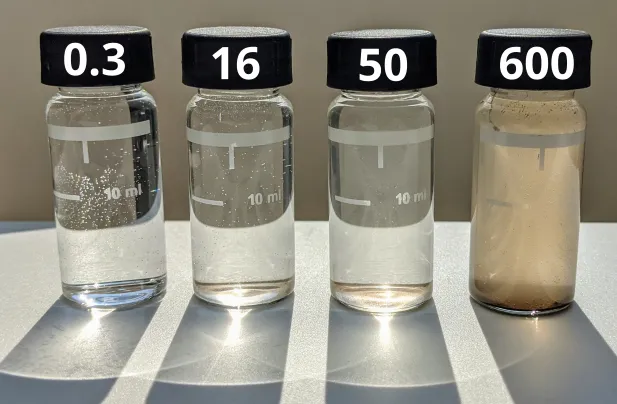
To keep drinking water safe, turbidity needs to be kept low. The World Health Organization advises that, for disinfection to work well, turbidity should ideally be below 1 NTU, and that small supplies with limited resources should aim to stay below 5 NTU. National standards vary, and well-run large supplies achieve much lower values. You can read more in turbidity meters and drinking water.
Reducing turbidity
There are several ways to reduce turbidity in water. A common method is coagulation and flocculation, in which chemicals are added to the water to make small particles clump together into larger ones. These can then be removed more easily by settling or filtration. Other methods include sedimentation basins, rapid sand filters and membrane filtration.
Natural turbidity
Although turbidity is often associated with pollution, it also occurs naturally. It can be higher at certain times of year, when snowmelt or heavy rain washes more sediment into rivers, and some rivers and reservoirs are naturally turbid because of the sediment they carry. Measuring turbidity continuously, for example with an in-river sensor such as Aquwell, shows how it rises and falls with rainfall and helps to separate natural changes from pollution events.
Summary
Turbidity is a measure of how cloudy water is, caused by small suspended particles such as clay, silt, algae and microorganisms. High turbidity can indicate pollutants or contaminants and can make disinfection less effective, so drinking water must be kept at low turbidity. It can be reduced by coagulation and flocculation, sedimentation, sand filtration or membrane filtration.